Choosing a China Top Freeze Dried Egg Yolk Supplier requires more than comparing prices. Product consistency, traceability, processing control, and communication all affect the final purchase decision. Freeze Dried Egg Yolk should deliver a clean egg aroma, even color, smooth rehydration, and stable performance in bakery, sauce, and food manufacturing applications.
A reliable supplier should explain its egg source, production process, drying temperature, moisture range, shelf life, and storage requirements. Requesting a current specification sheet and certificate of analysis is essential. Testing should cover microbiological safety, moisture, fat content, and solubility. These details matter when the powder arrives in sealed bags, not just inside a polished sales presentation.
Experience helps reveal small warning signs. A sample may look fine but dissolve unevenly in warm water. Packaging may also appear strong while lacking proper batch identification. Ask for production records, export experience, allergen statements, and third-party certification where applicable. HACCP or ISO 22000 systems can support confidence, but certificates should be checked carefully and matched with the actual factory.
Price still matters. It should not be the only measure. A lower quote may exclude testing, inner packaging, or customized labeling. Supplier reviews can help, but they are not complete proof. A practical evaluation combines samples, factory evidence, transparent communication, and repeatable quality. No supplier is perfect. Even a promising partner deserves ongoing checks before larger orders are approved.
China Top Freeze Dried Egg Yolk Supplier?
Freeze-dried egg yolk requires more than an attractive product sheet. Buyers should examine moisture, protein, and fat on a clearly stated testing basis. The figures 48–50% moisture, 16–18% protein, and 30–35% fat commonly resemble fresh egg yolk composition. They may not describe the final freeze-dried powder.
This distinction matters. Proper freeze-dried yolk powder usually has much lower residual moisture after processing. A reliable supplier should provide a recent certificate of analysis, testing methods, batch numbers, and storage conditions. Ask whether results use a wet basis or dry basis. Small wording differences can create major purchasing errors.
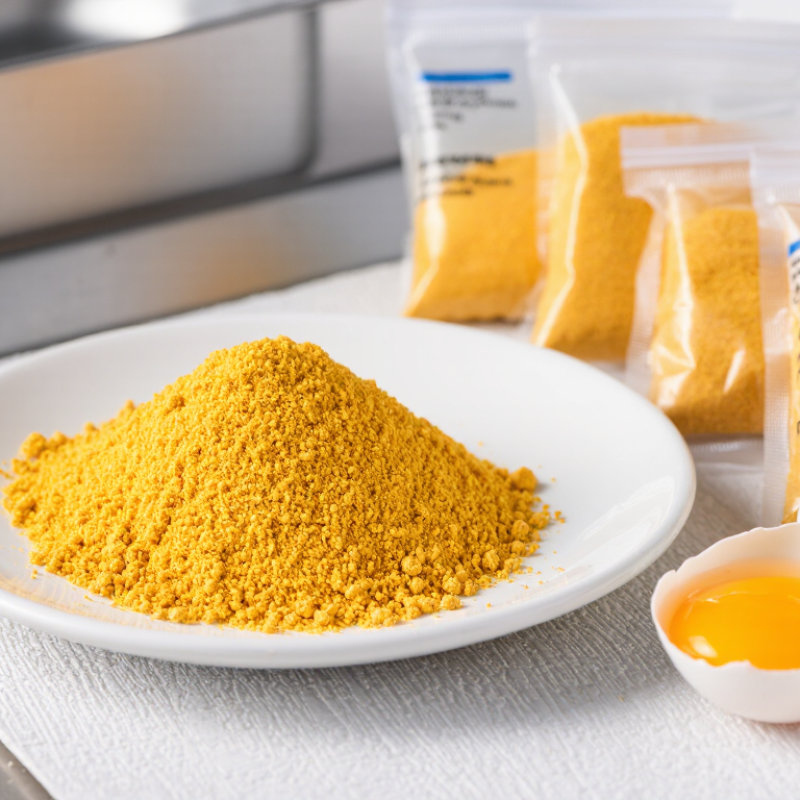
Look closely at the powder in practice. It should pour evenly, show a natural yellow color, and rehydrate without stubborn lumps. A clean egg aroma is expected. Rancid or sharply sour notes are warning signs. Fat content between 30% and 35% can support rich flavor and emulsification, while protein around 16–18% may suit bakery and sauce applications, depending on the calculation method.
Packaging also deserves attention. Moisture barriers, oxygen control, and cool storage help protect yolk fat from oxidation. I would request sample testing before approving a large order. My earlier assumption was that the subtitle described finished powder; that may be wrong. Specification details must settle it.
| Quality Dimension | Fresh Egg Yolk Reference | Typical Freeze-Dried Egg Yolk Powder | Why It Matters |
|---|---|---|---|
| Moisture | Approximately 48–50% | Typically ≤5%; many specifications target approximately 2–4% | Low moisture improves storage stability and helps limit microbial growth. |
| Protein | Approximately 16–18% | Approximately 30–35% by weight | Provides emulsifying and nutritional value; concentration increases after water removal. |
| Fat | Approximately 30–35% | Approximately 50–55% by weight | Supports flavor, mouthfeel, emulsification, and bakery performance. |
| Ash | Approximately 1–2% | Approximately 2–4% | Reflects the mineral fraction and can support basic composition verification. |
| Color | Yellow to orange-yellow | Yellow to golden-yellow powder | Color is influenced by hen diet, pigment content, processing, and oxidation control. |
| Solubility and Reconstitution | Naturally liquid and dispersible | Should disperse smoothly in water with limited lumping | Important for sauces, dressings, bakery mixes, and beverage applications. |
| Water Activity | High, because of the natural water content | Commonly controlled below 0.30 for a dry, shelf-stable powder | A lower value helps reduce the risk of microbial and enzymatic deterioration. |
| Storage Condition | Refrigerated and used promptly | Sealed, cool, dry, and protected from light and oxygen | Packaging performance is essential because yolk fat is susceptible to oxidation. |
| Analytical Basis | As-is fresh yolk composition | As-is freeze-dried powder composition | Values are not directly comparable unless the same moisture basis is used. |
Note: The 48–50% moisture, 16–18% protein, and 30–35% fat figures describe the typical composition of fresh egg yolk. Freeze-drying removes most water, so the powder normally has much lower moisture and proportionally higher protein and fat concentrations. Actual values vary with egg source, separation efficiency, drying conditions, and laboratory method.
Ask for monthly output records, dryer volume, shift logs, and recent shipment evidence. A brochure is not enough. Compare production claims with factory activity and pallet counts.
Records should connect approved farms, batch codes, processing dates, heat treatment, and laboratory results. During a visit, compare digital files with carton labels. Small gaps deserve attention.
Moisture should generally remain at or below 4%. This supports crisp particles, smoother flow, and slower quality loss. Test laboratory samples regularly, not once.
Moisture percentage alone can mislead. Many dry-food producers target water activity below 0.60. Use a calibrated meter at a controlled temperature. Low water activity does not eliminate Salmonella risk.
Test moisture, water activity, Salmonella, aerobic plate count, yeast, mold, and fat content. The intended recipe may require extra testing. One passing report proves little.
It should show the lot number, sampling date, test methods, results, and release decision. Review at least three recent certificates. Perfect paperwork can still hide weak sampling.
Packaging should remain dry, tightly sealed, and free from oily clumps. Check for darkened particles, damaged seals, and moisture inside cartons. Ask for production-floor photographs.
Request samples from different production lots and compare solubility, color, fat, and recipe performance. Ask the supplier to explain any deviation. Independent testing remains necessary. I would not rely on promises alone.
Choosing a reliable Freeze Dried Egg Yolk supplier requires more than comparing prices. Start by understanding the product’s basic composition, including its typical moisture, protein, and fat levels, then evaluate the supplier’s production capacity, egg traceability system, and experience serving export markets. A dependable supplier should be able to provide consistent raw material sourcing and clear documentation throughout the supply chain.
Quality verification is equally important. Finished powder should generally meet strict benchmarks for moisture, water activity, microbial safety, and shelf stability. Buyers should request HACCP, ISO 22000, or BRCGS certifications where applicable, together with a current COA and batch-specific test results. Finally, compare MOQ, pricing, lead time, packaging, shelf life, and certification coverage before making a decision. A thorough evaluation helps ensure product consistency, food safety, and a stable long-term supply.

 GAGA